Hamza Salah

Data Science (M.S. graduate), passionate about building ML and forecasting solutions across diverse domains.


Retail Demand Forecasting
Summary
Retail Demand Forecasting demonstrates how statistical modeling and time series analysis can transform retail decision-making. Incorporating seasonality and promotional data through SARIMAX enables accurate, actionable demand predictions-driving smarter inventory management and higher profitability.
Visualizations & Tables

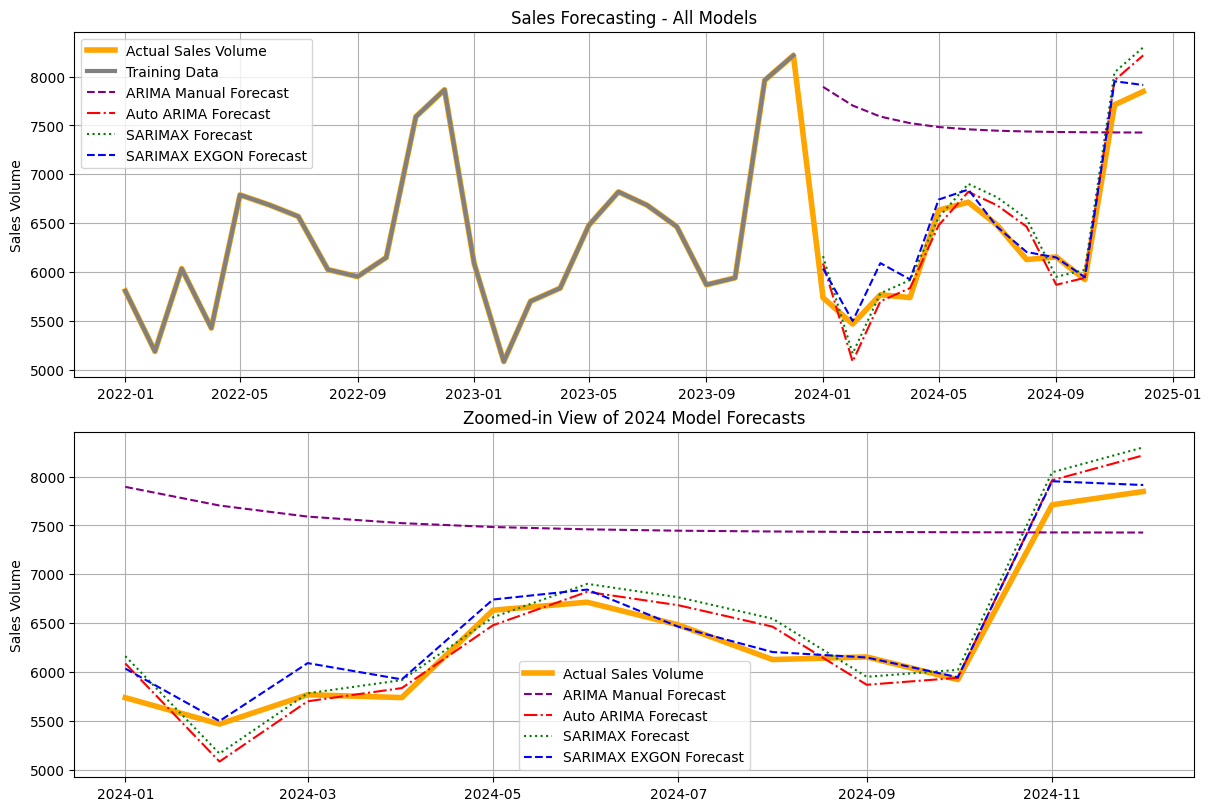
Key Insights
- SARIMAX models achieved the lowest RMSE (165.10), outperforming ARIMA and Auto ARIMA by accounting for seasonality and promotions.
- Promotions had a measurable positive effect on sales volume, especially during peak seasons.
- Toys showed steady growth, while Electronics and Apparel exhibited cyclical demand patterns.
- Accurate forecasts can directly reduce overstocking, stockouts, and inventory carrying costs.
Code and Data
- Dataset:
- Synthetic Retail Sales Dataset — Kaggle
- 3 years of daily sales data across multiple product categories
- Data Cleaning & Preparation:
- Converted and standardized date fields
- Created time-based features (Year, Month, Year-Month)
- Aggregated daily sales to monthly totals
- Split dataset into training (pre-2024) and testing (2024) sets
- View Paper
Technologies Used
- Python (Pandas, NumPy, Statsmodels, Pmdarima, Scikit-learn, Matplotlib, Seaborn)
- Jupyter Notebook for analysis and modeling
- Interactive Plotly dashboard for visualization and exploration
Recommendations
- Deploy SARIMAX forecasting to improve real-time retail demand prediction.
- Integrate external features (weather, holidays, pricing) to improve accuracy.
- Use forecasts to align marketing and inventory decisions:
- Plan promotions during forecasted high-demand periods.
- Adjust stock levels proactively to prevent shortages or overstocking.
Risks and Ethical Considerations
- Data Limitations: Synthetic datasets may not fully reflect real-world behavior.
- Ethics: Only non-sensitive, publicly available data were used.
- Mitigation: Retrain models periodically using fresh and validated datasets.