Hamza Salah

Data Science (M.S. graduate), passionate about building ML and forecasting solutions across diverse domains.


Predictive Modeling of Retail Inventory Inaccuracy (IRI) for Audit Prioritization
For a detailed backstory on what inspired me to create this project, please read my article on Medium: Modeling of Retail IRI for Audit Prioritization
Project Overview
Developed a predictive model to identify high-risk inventory items 24 hours in advance. Lacking access to realistic data, I simulated a retail environment and trained a Logistic Regression classifier, achieving an F1-Score of 0.83.
Key Insights
-
Primary Predictor: Low stock status (
In_stock_t) was identified as the strongest signal of imminent IRI risk. The model assigned it the highest feature importance (coefficient: -1.34), far outweighing other features, indicating that items approaching a “stock-out” status are the critical driver of inventory discrepancies. -
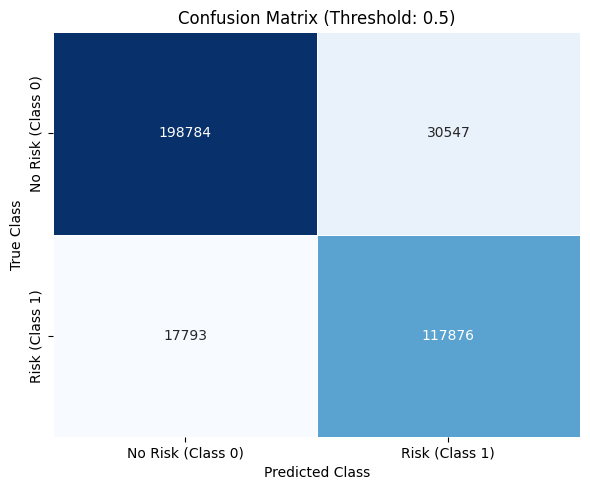
Model Performance: The model achieved an F1-Score of 0.83 on the critical positive risk class (exceeding the 0.70 target) and demonstrated excellent discriminatory power with an AUC of 0.92 on the held-out validation set.
-
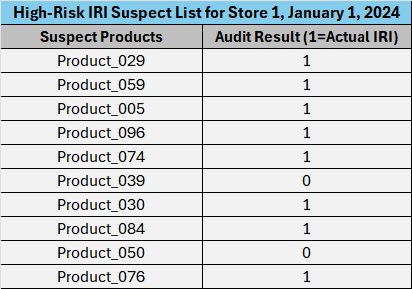
Operational Impact: A “Virtual Audit” conducted on the model’s predictions confirmed an 80% success rate in identifying discrepancies. This validates that a high-accuracy Suspect List can effectively optimize labor by focusing resources exclusively on high-probability errors.
-
Data Handling: Class imbalance (38% IRI cases) was managed effectively without oversampling, prioritizing evaluation strictly on the F1-Score of the minority risk class.
Code and Data
Key Visualizations
Technologies Used
- Python (Pandas, NumPy for simulation)
- Scikit-learn (Logistic Regression, OneHotEncoder)
- Jupyter Notebook
- Matplotlib, Seaborn